
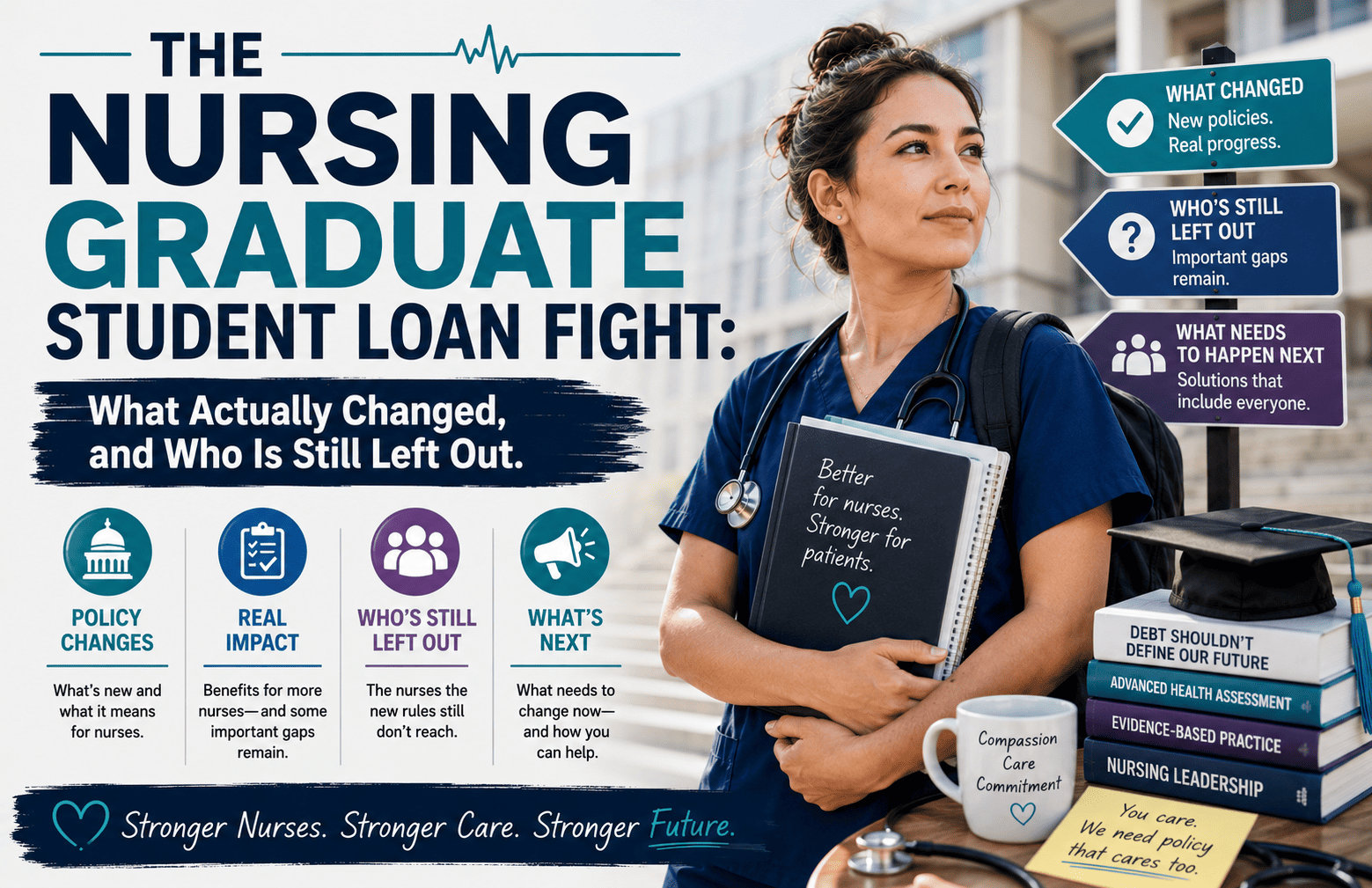
If you’re trying to figure out how much you can borrow through the federal student loan program for a graduate nursing degree right now, here’s the honest answer: the limits are currently in flux due to ongoing deliberation and litigation pertaining to the new federal student loan limit reductions in the One Big Beautiful Bill Act of 2025. Please note that nothing stops you from borrowing from a private lender at whatever terms you can get. However, federal student loan limits for MSN, DNP, DNAP, and PhD nursing students have changed three times since April, each change resulting from a specific court ruling or agency decision. It’s highly likely that the rules will change again. The good news is that we will continue to update this article to track graduate nursing degree federal loan limits as they currently stand so you can plan with confidence.
Where Graduate Nursing Students Stand Right Now by Degree
| Degree | Status as of July 23, 2026 | What it means |
| MSN | Professional Degree (interim) | Eligible for $50,000/year and $200,000 aggregate under the Department’s June 29, 2026 interim guidance, while litigation continues. |
| DNP | Professional Degree (interim) | Same interim treatment as MSN. |
| DNAP | Professional Degree (interim) | Same interim treatment as MSN and DNP. This is the credential path for CRNAs, and it’s the one where the old $100,000 cap was most likely to fall short of actual tuition. |
| PhD (Nursing) | Graduate (unsettled) | Excluded from every version of the professional degree list published so far, including the July 10, 2026 update. Capped at $20,500/year and $100,000 aggregate. |
Background on Current Situation for Nursing Graduate Degree Federal Student Loans
Here’s where things sit today. As of July 23, 2026, the U.S. Department of Education (ED) is treating MSN, DNP, and DNAP programs as “professional degrees”. This designation unlocks the higher federal loan caps, which are $50,000 a year and $200,000 in aggregate. Note that nursing PhD programs are not on that list. PhD students remain capped at $20,500 a year and $100,000 in aggregate, which is the same limit that applies to any other graduate program in the country that ED has not classified as a “professional degree”.
Two different things are going on here, but they’re not two different legal fights. The MSN/DNP/DNAP professional-degree inclusion traces back to a June 24, 2026 court ruling that ruled ED’s original exclusion of nursing from its professional-degree definition was likely unlawful and blocked it. However, that ruling didn’t specify exactly which nursing degrees ED had to add back to the list of professional-degrees. ED made that call itself in interim guidance it issued June 29. ED chose to include MSN, DNP, and DNAP while leaving PhD off.
Meanwhile, the ongoing lawsuits behind that ruling, and a separate ANA-led suit still pending, challenge ED’s exclusion of nursing broadly. Neither carves PhD out. So the PhD gap isn’t waiting on a separate legal theory. Instead, it’s waiting on the same cases to go further than the preliminary relief they’ve produced so far, or on pending federal legislation called the “Nursing is a Professional Degree Act”, or on ED revising its own interim list again the way it did for Clinical Psychology on July 10, 2026.
There are two very important things to know regardless of your degree type. First, there’s a separate protection that has nothing to do with the professional/graduate classification fight. Specifically, if you were already enrolled in and borrowing for your program before July 1, 2026, then you likely qualify for a legacy exception that lets you keep the old, higher Grad PLUS-era terms for up to three years or until you finish your credential, whichever comes first, as long as you stay continuously enrolled. If you take a leave or a break in enrollment, that protection ends and the new caps apply. Confirm your status with your program’s financial aid office. Don’t assume.
Second, Grad PLUS loans are gone for new borrowers who don’t qualify for that legacy exception, regardless of degree type. That change took effect July 1, 2026, along with two new federal repayment plans (Tiered Standard and the income-based Repayment Assistance Plan, or RAP), and it was not affected by the court order. The professional degree fight only determines your annual and lifetime caps under the Direct Unsubsidized Loan program. It doesn’t undo the broader loan overhaul.
How we got here: the timeline, with dates
Knowing how we got here is helpful to understanding where we are now and why things are still in flux.
July 4, 2025. President Trump signs the One Big Beautiful Bill Act (OBBBA, H.R. 1, Public Law 119-21) into law. Among its many changes to federal student aid, the law replaces the old graduate lending structure with a two-tier system, effective July 1, 2026. Tier 1 is graduate students capped at $20,500 a year and $100,000 in aggregate. Tier 2 is “professional” students capped at $50,000 a year and $200,000 in aggregate. It also phases out Grad PLUS loans for new borrowers. Note that the law itself doesn’t define which degrees count as “professional.” Instead, the law ties the term to the regulatory definition at 34 CFR 668.2 “as in effect on the date of enactment”. 34 CFR 668.2 is a 1965 regulation that lists 10 fields as professional but frames the list as illustrative, not exhaustive: it says examples “include but are not limited to” that list. As a result, ED is supposed to work out through negotiated rulemaking exactly which degree programs qualify. That delegation is what put nursing’s classification in ED’s hands in the first place.
November 6, 2025. The Department of Education’s Reimagining and Improving Student Education (RISE) rulemaking committee ruled that the professional degree definition covers just 11 fields: medicine, dentistry, law, pharmacy, veterinary medicine, optometry, osteopathic medicine, podiatry, chiropractic, theology, and clinical psychology. The logic behind their defining it this way leaned on the regulatory language dating to 1965. At that time, graduate nursing programs were treated as academic rather than as first-professional credentials. Therefore, the committee left nursing off entirely, along with physician assistant, physical therapy, audiology, and several other health fields.
December 12, 2025. More than 140 members of Congress, including 12 Republicans and led by Sen. Jeff Merkley (D-OR), Sen. Roger Wicker (R-MS), Rep. Jen Kiggans (R-VA), Rep. Suzanne Bonamici (D-OR), and Sen. Susan Collins (R-ME), sent a bipartisan letter to Under Secretary of Education Nicholas Kent asking the Department to correct the exclusion and add post-baccalaureate nursing to its professional degree list before the rule was finalized.
Winter 2026. The pushback widened. An ANA petition drew more than 245,000 signatures. The rulemaking committee received thousands of public comments. A Nurse.org poll of 2,312 nurses found that 59% said the proposed caps made them less likely to pursue a graduate degree at all which validated concerns that these changes would further reduce the already deficient pipeline for these critical modalities.
April 30, 2026. None of it moved the needle. ED finalized the RISE rule essentially unchanged. They classified graduate nursing programs as ordinary “graduate” degrees, not “professional” ones. That capped borrowing at $20,500 a year and $100,000 aggregate, versus $50,000 and $200,000 for the eleven fields ED did designate as professional. Grad PLUS loans were eliminated for new borrowers without a legacy exception. ANA called the decision a profound disappointment, noting the rule dropped one week before National Nurses Week.
May 2026. Four separate legal and legislative pushes landed within a few weeks of each other. Sens. Merkley and Wicker introduced the bipartisan Nursing is a Professional Degree Act (S. 4568), which would amend the Higher Education Act to explicitly include MSN, DNP, DNAP, and PhD nursing degrees in the professional definition. A companion bill was introduced in the House by Rep. Kiggans. A coalition of roughly two dozen states and Washington, D.C. filed a federal lawsuit challenging the rule. Separately, the American Association of Nurse Practitioners (AANP), the American Association of Colleges of Nursing (AACN), and several other health and education organizations filed their own suit, later joined by additional plaintiffs and consolidated into a single case. The American Nurses Association, joined by nine other national nursing organizations, filed yet another lawsuit on May 29, which remains pending separately.
June 24, 2026. In the consolidated AANP/AACN case, U.S. District Judge Beryl Howell granted preliminary relief, finding the plaintiffs had shown ED’s professional degree definition was likely unlawful. The ruling blocked the narrow definition just days before it was set to take effect, covering not just nursing but also physical therapy, occupational therapy, audiology, athletic training, architecture, and several other fields swept up in the same rulemaking.
June 29-30, 2026. ED responded with what it called interim guidance. That guidance expanded the list of professional degree programs for the duration of the stay and included MSN, DNP, and DNAP nursing programs. The Department was explicit that these are administrative designations tied to the court order and “may change as litigation in the case proceeds.” Note that ED did not add Nursing PhD programs to the list.
July 1, 2026. The rest of the RISE rule took effect on schedule. This means that everything else, including the Grad PLUS phaseout and the new repayment plans, moved forward as ED had initially planned. However, the professional degree fight is still unsettled.
July 10, 2026. ED issued a follow-up clarification. This clarification expanded which specific CIP subcodes within the MSN and DNP categories qualify, and fixed an error that had accidentally left the Clinical Psychology PhD off the interim list. Note that ED still did not alter its treatment of nursing PhDs. As of this writing, that’s still true. Moreover, ED has said it remains confident their original, narrower definition is lawful and intends to keep defending it in court.
The PhD gap nobody’s talking about enough
Here’s the part of this story that gets lost when the headline is “nursing wins its case.” Nursing didn’t fully win, and the part that did land wasn’t the result of two separate legal fights. The lawsuits behind the June 24 ruling challenge ED’s exclusion of nursing from the professional degree definition as a category, not degree by degree. Moreover, nothing in those complaints singles PhD out for different treatment. What actually left PhD off the professional list was ED’s own interim guidance which added MSN, DNP, and DNAP but not PhD. That was ED’s implementation choice, not something the court’s order required. However, it’s a separate question from how the underlying case eventually resolves.
Why does that matter more than it might seem to? Because PhD-prepared nurses aren’t primarily headed to the bedside. They’re the pipeline for nursing school faculty and nurse scientists. They’re the people who teach the next generation of RNs, NPs, and CRNAs, and who run the research upon which nursing leaders build advanced practice guidelines. AACN’s most recent Special Survey on Vacant Faculty Positions put the national nursing faculty vacancy rate at 7.2%, with the vast majority of open positions requiring or preferring a terminal degree. Schools have been turning away tens of thousands of qualified applicants to nursing degree programs every year. Schools consistently cite faculty shortages as the leading reason, alongside limited clinical placement capacity and classroom space.
Cap PhD annual borrowing at roughly 40% of what MSN and DNP students can access, and half their lifetime aggregate, and you’re making the most academically demanding, lower-paying track in nursing education harder to finance than the clinical tracks that lead to higher-paying jobs. That’s a strange incentive to build into federal policy at a moment when nursing schools already can’t hire enough faculty to meet demand. It’s also a slow-moving problem. A nurse who starts a PhD today won’t be teaching a cohort of new RNs for years. If financing gets harder now, the faculty shortfall shows up on a delay, right when today’s enrollment surge would otherwise be producing more nurses, not fewer.
Why this matters even if your loans are long paid off
It’s easy to read all of this as a story about students, but the downstream effects land on every working nurse, including the ones who will never take out another federal loan.
Fewer PhD-prepared faculty means nursing schools admit fewer students, because faculty-to-student ratios in clinical rotations are enforced, not optional. Fewer admitted students means a smaller RN pipeline in five to ten years, at the exact moment retirements and burnout-driven attrition are already thinning the workforce. If the interim protection for MSN, DNP, and DNAP borrowers is later reversed as the litigation plays out, growth in that pipeline could slow too, particularly in the rural and underserved areas that lean hardest on nurse practitioners and CRNAs.
For anyone working travel or per diem assignments, this is the kind of policy fight that shapes the staffing environment two or three years out. Facility-level shortages in specialties like anesthesia and primary care don’t materialize overnight. They build slowly, from fewer graduates entering the pipeline years earlier, and they show up eventually as higher demand and tighter competition for experienced clinicians in exactly the kind of high-acuity, hard-to-staff roles that travel nursing exists to fill. A policy fight over PhD loan caps in 2026 is, in a roundabout way, a preview of the staffing market in 2030.
We’re keeping this page updated
This is a live legal and regulatory fight with at least three active lawsuits, a pending bill in Congress, and a Department of Education that has said it plans to keep defending its original, narrower rule. The interim guidance covering MSN, DNP, and DNAP programs is unsettled and tied to ongoing litigation, with no fixed date for when or whether it changes again. It could be extended, narrowed, or reversed with very little notice, the same way it’s already changed twice since April, or it could hold as-is for months while the cases work through the courts.
We’ll revise this page as the litigation and rulemaking move. Check the “last updated” date at the top before you make a financing decision based on anything below it, and if you’re currently enrolled or about to enroll, confirm your specific situation with your program’s financial aid office rather than relying on any single article, including this one.
Sources
- U.S. Department of Education, Office of Federal Student Aid, “Update to List of Professional Degree Programs Due to Court Order” (updated July 10, 2026)
- American Association of Colleges of Nursing, “Federal Court Blocks Department of Education Definition of ‘Professional Degree'” (June 25, 2026)
- American Association of Colleges of Nursing, “Department of Education Adds Nursing Degrees to its Interim List of Professional Degree Programs” (June 30, 2026)
- Washington State Nurses Association, “Nursing graduate degrees designated ‘professional’ — for now”
- Washington State Nurses Association, “ANA and 9 nursing organizations sue federal government over loan limits”
- Congress.gov, S.4568 — Nursing is a Professional Degree Act, 119th Congress
- Office of Sen. Jeff Merkley, “Merkley, Wicker Launch Bipartisan Effort to Overturn New Limits on Student Loans for Nurses”
- American Organization for Nursing Leadership, “More than 140 lawmakers urge nursing to be classified as ‘professional degree'”
- American Association of Colleges of Nursing, Faculty Shortage Fact Sheet and 2025 Special Survey on Vacant Faculty Positions
- ABC News, “Nursing gains ‘professional’ label for student loans after judge’s ruling”
- U.S. News & World Report, “What’s a Nursing Student to Do? Answering Your Questions While the Professional Degree Mess Gets Sorted Out” (July 10, 2026)
- Nurse.org, “Judge Blocks Rule That Stripped Nursing of ‘Professional’ Degree Status”
- Nurse.org, “New Bill + 24-State Lawsuit Push to Classify Nursing as a ‘Professional’ Degree”
This article is for informational purposes and isn’t financial or legal advice. Loan eligibility depends on your individual enrollment status, program, and timing. Talk to your school’s financial aid office about your specific situation.