The hardest part of your first travel nurse assignment usually isn’t the nursing. It’s everything that has to happen before you ever walk onto the unit.
You create a profile. Gather documents. Apply for jobs. Wait for submissions. Interview. Review an offer. Complete credentialing. Get licensed if necessary. Find housing. Travel to a city you may have never visited. Then, after weeks of paperwork and logistics, you’re expected to walk into an unfamiliar hospital and start taking patients with a fraction of the orientation a staff nurse receives.
That’s travel nursing.
The good news is that the process becomes much easier once you know what is coming. If you’re wondering how to become a travel nurse or how long it takes to get a travel nursing job, this guide walks through the entire process, week by week, from your first application through your first shift.
How Long Does It Take to Get a Travel Nursing Job?
For a first-time traveler, a reasonable planning window is about four to eight weeks from starting the process to beginning an assignment.
It can happen faster. Stability Healthcare reports that the typical time from completing a profile to starting an assignment is about four weeks, and in unusually fast situations it can be much shorter.
But don’t build your first travel assignment around a best-case scenario.
The timeline depends heavily on:
- Whether your application file is complete
- Your specialty and experience
- How selective you are about location, facility, shift, and pay
- Whether you already hold the required state license
- How quickly the hospital interviews and makes decisions
- Background checks and employment verification
- Occupational health and credentialing requirements
- How quickly you complete requested paperwork
Licensing is one of the biggest wild cards. If you already have a multistate license through the Nurse Licensure Compact and are taking an assignment in another compact state, licensing may be relatively simple. If you need a new license by endorsement, the process can add weeks or, in some states and circumstances, much longer.
That’s why the best way to think about your first assignment isn’t, “How quickly can I get a contract?”
It’s, “What needs to be ready so I can move quickly when the right contract appears?”
Before Week 1: Make Sure You’re Actually Ready to Travel
Travel nursing isn’t generally an entry-level nursing job.
Facilities hire travelers because they have staffing needs they need solved quickly. They usually aren’t looking for someone who needs months of training on the specialty.
Stability requires at least one year of recent U.S. acute-care experience for its travel nursing program and notes that many facilities provide a week or less of orientation. Depending on the specialty and facility, more experience may be expected.
For a first-time traveler, having roughly 18 months to two years of solid recent experience in your specialty can make the transition considerably easier.
You should be comfortable managing a normal patient assignment in your specialty, documenting independently, communicating with physicians and other departments, prioritizing care, and adapting when a unit does things differently from your current hospital.
You don’t need to know everything.
You do need to be able to function without the safety net of a long staff orientation.
What Documents Should You Gather Before Applying?
This is one of the easiest ways to make your first travel assignment less stressful.
Don’t wait until you’ve found the perfect job to discover that your ACLS card is missing or nobody can remember the exact dates you worked at a hospital four years ago.
Create a digital folder for your travel nursing documents before you begin applying.
At minimum, gather:
Professional documents
- Current nursing license information
- Compact license information, if applicable
- BLS card
- ACLS, PALS, NRP, TNCC, NIHSS, or other specialty certifications
- Specialty certification, if applicable
- Current resume or complete employment history
- Nursing school and graduation information
Employment information
- Names of previous employers
- Exact or approximate employment dates
- Units and specialties worked
- Supervisor or manager names
- Contact information for professional references
Identity and onboarding documents
- Government-issued identification
- Documents required to establish authorization to work in the United States
- Social Security information when requested through the secure onboarding process
- Direct-deposit information
- Emergency contact information
Health and compliance records
Requirements vary by facility, but you may eventually need documentation involving:
- Physical examination or health statement
- TB testing
- Immunization records or titers
- Drug screening
- Background check
- Fit testing
- Facility-required competency testing
Don’t email sensitive documents randomly to anyone who asks for them. Your staffing company should provide a secure process for submitting personal and compliance information.
The more complete your file is before submission, the fewer opportunities there are for a preventable delay later.
Week 1: Create Your Profile and Define What You Actually Want
Your first week is about getting into the system and deciding what kind of assignment you’re willing to accept.
With Stability Healthcare, you can create an account, search available assignments, see pay information and hospital details, and apply to jobs through the self-service platform while still having recruiter support when you need it.
Before applying everywhere, decide what matters most.
Think about:
- States or cities you’re willing to consider
- Day versus night shift
- Minimum acceptable weekly compensation
- Desired start date
- Maximum commute
- Whether you’re bringing a spouse, children, or pets
- Whether you need to be near a major airport
- Whether you’ll have a car
- Whether you’re willing to float
- Hospital size or trauma-level preferences
- Scheduling requirements
Then decide which of those are requirements and which are merely preferences.
This distinction matters.
If you need San Diego, day shift, a specific start date, no floating, three consecutive shifts, and compensation above a particular number, there may be very few jobs that satisfy every condition.
That’s fine if you’re willing to wait.
But flexibility usually increases your options and can shorten the time it takes to land your first assignment.
Week 1 to 2: Apply and Get Submitted
Finding a job posting isn’t the same as being submitted for the job.
Once you identify an assignment you’re interested in, your staffing company needs to make sure you’re qualified and prepare your profile for submission to the facility.
The hospital may receive candidates from multiple staffing companies, and attractive assignments can move quickly.
This is why having your documentation ready matters.
If an agency spends two days chasing your references, updated resume, certification cards, and license information, the hospital may already be interviewing someone whose file was complete.
For competitive assignments, speed matters after you’ve decided you genuinely want the job.
That doesn’t mean applying indiscriminately. Ask important questions before submission, including whether you’re comfortable with the shift, location, estimated compensation, start date, and major job requirements.
Once you’re submitted, be ready to answer your phone.
Week 2: The Interview
Travel nursing interviews are often much shorter and more practical than interviews for permanent positions.
The manager already knows you’re temporary. They aren’t necessarily trying to determine whether you fit the hospital’s five-year leadership development plan.
They want to know whether you can safely do the job they need done.
Expect questions about:
- Your recent specialty experience
- Patient ratios you’ve handled
- Types of patients you routinely care for
- Equipment and charting systems you’ve used
- Certifications
- Charge experience
- Floating experience
- Your availability and start date
But the interview is also your opportunity to interview the hospital.
Ask about typical ratios, floating expectations, scheduling, weekends, call requirements, orientation, charting system, scrub requirements and the types of patients you’ll actually be expected to manage.
One particularly useful question is:
“What does orientation look like for travelers?”
The answer tells you a lot.
You may get only a few orientation shifts. Stability specifically notes that many facilities provide travelers one week or less of orientation.
That’s why travelers are expected to arrive clinically ready.
Week 2 to 3: The Offer
If the interview goes well, an offer can come quickly.
Don’t let excitement about getting your first travel nurse assignment stop you from reviewing the actual terms.
Look beyond the headline weekly number.
Review:
- Taxable hourly rate
- Housing and meal stipends, when applicable
- Guaranteed hours
- Overtime rate
- Extra-shift compensation
- Start and end dates
- Shift
- Required weekly hours
- Cancellation provisions
- On-call requirements
- Weekend requirements
- Floating expectations
- Travel reimbursement
- Benefits
- Requested time off
Make sure anything important that was discussed during the interview is reflected appropriately in your agreement or confirmed before you sign.
This is also the point where you need to be prepared for an uncomfortable reality of travel nursing:
Until you have an accepted offer, you don’t have the assignment.
Jobs can close. Hospitals can fill positions internally. Census can change. Budgets can change.
Avoid making expensive, nonrefundable commitments too early.
Week 3 to 5: Credentialing and Compliance
You signed the contract.
Now comes the least glamorous part of travel nursing.
Credentialing.
The staffing company and facility need to verify that you’re cleared to work. Depending on the assignment, this can involve employment verification, background screening, drug testing, occupational health requirements, competency testing, certifications, facility modules and other documentation.
This is where a surprising number of start dates get threatened.
The problem isn’t always that something is wrong. Sometimes a lab result hasn’t posted. A former employer hasn’t responded to verification requests. A document expired. A facility adds a requirement. Someone misses an email.
Treat compliance requests as time-sensitive.
If your credentialing specialist asks for something Monday morning, don’t plan on getting around to it Friday afternoon.
A missing document that seems trivial to you can be a hard stop for the hospital.
Licensing Can Be the Biggest Timeline Variable
If the assignment requires a new state nursing license, start that process as early as possible.
Licensing timelines vary dramatically by state.
Some boards process applications relatively quickly. Others can take weeks or longer, particularly when fingerprinting, transcripts, primary-source verification, education reviews, or missing application materials are involved.
This is one reason compact licensure can be so valuable for eligible nurses. A nurse who holds a multistate license may be able to work in another compact state under that privilege without obtaining a separate license for every assignment.
For noncompact states, however, don’t assume your license will arrive just because the hospital offered you a job with a particular start date.
Ask your recruiter whether the proposed timeline is realistic before committing to travel arrangements.
Week 4 to 6: Find Housing
Once your contract and start date look solid, housing becomes the next major project.
Your main choices are generally furnished apartments, extended-stay hotels, short-term rental platforms, private landlords, or furnished rooms.
For a first assignment, prioritize reliability and commute over Instagram appeal.
A beautiful apartment 45 minutes from the hospital can become considerably less beautiful after three consecutive 12-hour shifts.
Before paying a deposit, verify:
- Actual commute time during your shift-change hours
- Parking
- Utilities
- Furnishings
- Laundry
- Lease length
- Cancellation terms
- Pet rules
- Neighborhood
- Internet access
- What happens if your assignment dates change
And be careful with large nonrefundable upfront payments.
Travel contracts are more vulnerable to schedule changes and cancellations than permanent jobs. Housing flexibility has value.
Week 5 to 7: Final Clearance and Travel
As your start date approaches, you should receive confirmation that you’ve cleared compliance.
Don’t confuse “I’ve completed everything they asked me to do” with “I’ve been cleared to start.”
Those aren’t always the same thing.
Before beginning a cross-country drive or boarding a flight, confirm your start date and reporting instructions.
You should know:
- Where to report
- What time to arrive
- Who your contact is
- Where to park
- What identification to bring
- What to wear
- Whether orientation is classroom, online, or on the unit
- Whether additional testing is required
Try to arrive in your new city at least a little before your first day.
Moving across the country Sunday night and starting hospital orientation at 6:30 Monday morning is possible.
It is not ideal.
Give yourself time to find the hospital, buy groceries, unpack, test the commute, and deal with whatever small problem inevitably appears.
Week 6 to 8: Your First Day
Your first day may feel surprisingly similar to starting any hospital job.
Expect some combination of HR paperwork, badges, parking, computer access, EMR training, policies, medication systems, competency assessments, unit orientation, and mandatory education.
The difference is speed.
Staff nurses may receive weeks or months of orientation.
Travelers generally don’t.
You may spend a day or two learning systems and policies, complete a handful of unit orientation shifts, and then be expected to function independently.
Nobody expects you to know where every supply closet is on day one.
They do expect you to know how to be a nurse.
What Your First Week on Assignment Is Actually Like
The first week can be disorienting, even for an experienced clinician.
You know how to care for patients. What you don’t know is how this hospital does everything.
Where are supplies?
Who starts difficult IVs?
How do you contact respiratory?
Where do you find the bladder scanner?
Which physician group covers this patient?
What’s the process for transport?
How does this hospital handle admissions?
Who do you call when the computer won’t let you chart something?
None of those questions mean you’re unprepared. Every hospital has its own workflows.
The fastest way to adapt is to identify helpful people early.
Find the charge nurses, experienced staff nurses, unit secretary, nursing assistants, pharmacists, respiratory therapists, and other people who know how the hospital actually works.
Ask questions.
Write things down.
Don’t pretend you understand a process when you don’t.
At the same time, expect some units to be genuinely difficult.
Hospitals generally don’t hire travelers because they’re perfectly staffed. You may walk into a unit dealing with vacancies, high census, turnover, or burnout. Travelers sometimes float frequently. You may not receive the schedule you would have chosen. Some assignments simply aren’t great.
That’s part of the tradeoff.
The goal of your first week isn’t to decide whether you’ve discovered your dream hospital.
It’s to become safe, functional, and comfortable enough with the system that you can do the job you were hired to do.
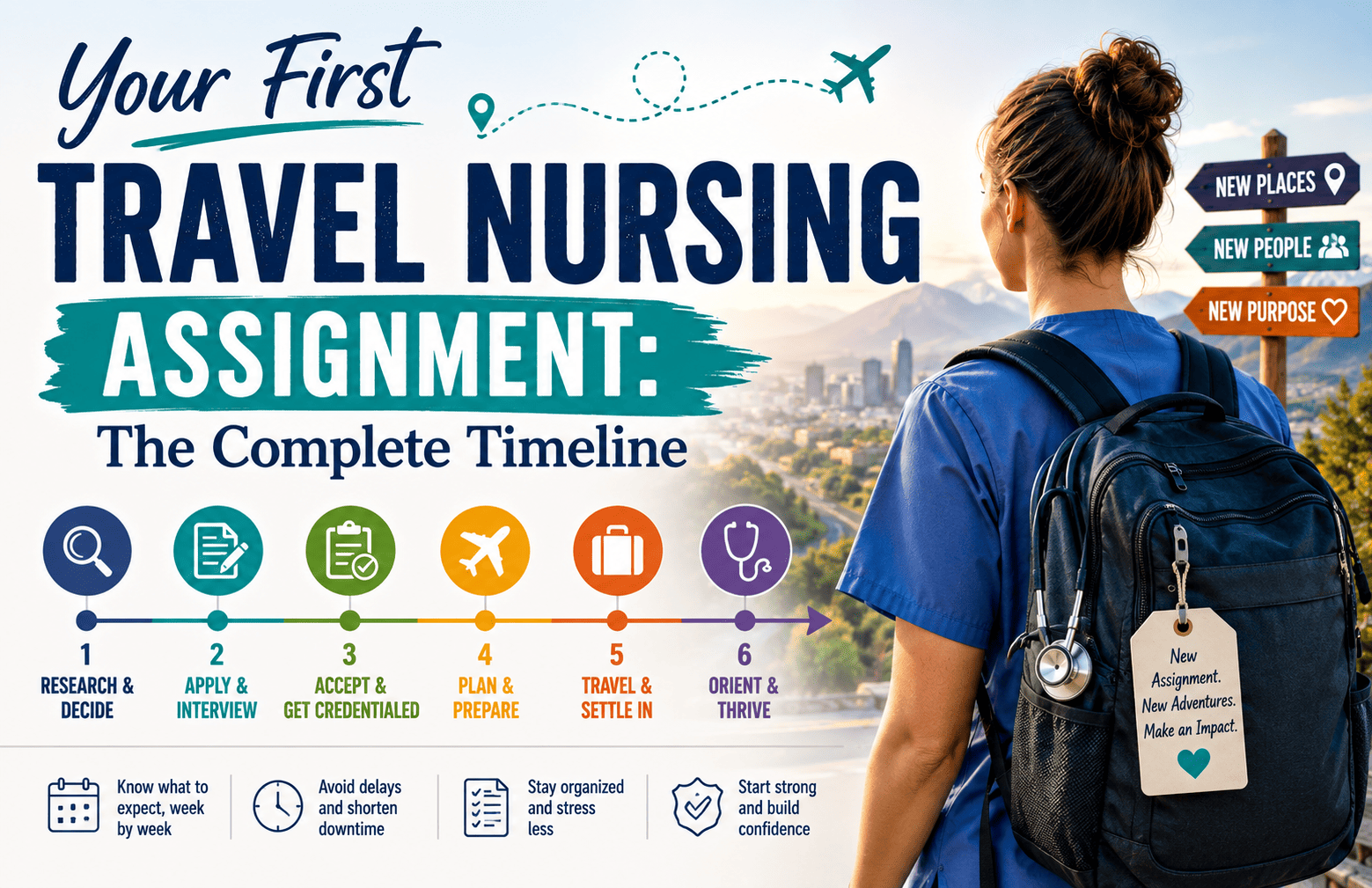
A Realistic First Travel Nurse Assignment Timeline
For a relatively straightforward first assignment, the process might look like this:
Week 1: Create your profile, gather documents, establish preferences, and begin applying.
Week 1–2: Apply to appropriate jobs and get submitted to facilities.
Week 2: Interview with a manager.
Week 2–3: Receive and evaluate an offer, then sign the agreement.
Week 3–5: Complete credentialing, background screening, occupational health requirements, and facility compliance.
Week 3–6+: Complete state licensing if a new license is required. This can substantially extend the timeline.
Week 4–6: Secure housing and make travel arrangements once the assignment is sufficiently firm.
Week 5–7: Receive final compliance clearance and reporting instructions.
Week 6–8: Travel to the destination and begin orientation.
Could you go from application to assignment faster than that? Absolutely.
Could licensing or credentialing turn an eight-week process into something longer? Also absolutely.
For your first assignment, give yourself room for the second possibility.
Ready to Start Your First Travel Nursing Assignment?
Your first assignment has more moving pieces than the assignments that come after it.
Once you’ve built your profile, collected your records, learned how submissions work, and gone through credentialing once, the process becomes much more familiar.
But you shouldn’t have to figure out the first one alone.
Stability Healthcare combines a modern self-service platform with actual recruiter support. You can search thousands of assignments, review pay packages and hospital information, apply on your own schedule, and still have an experienced team helping you through submission, credentialing, licensing, housing, and the transition to your assignment.
And clinicians have noticed. BluePipes ranked Stability Healthcare the #1 travel nursing company in America for 2026, first among more than 450 agencies evaluated using nearly 230,000 clinician reviews across five major review platforms. Stability’s aggregate review score increased from 88.26 to 92.49 over the past year across more than 1,000 reviews.
If you’re thinking about your first travel assignment, you don’t need to commit to a job just to see what’s available.
Create a free Stability Healthcare account, build your profile, and start comparing assignments that match your specialty, license, and priorities.
Your first travel nursing assignment starts with knowing your options.