
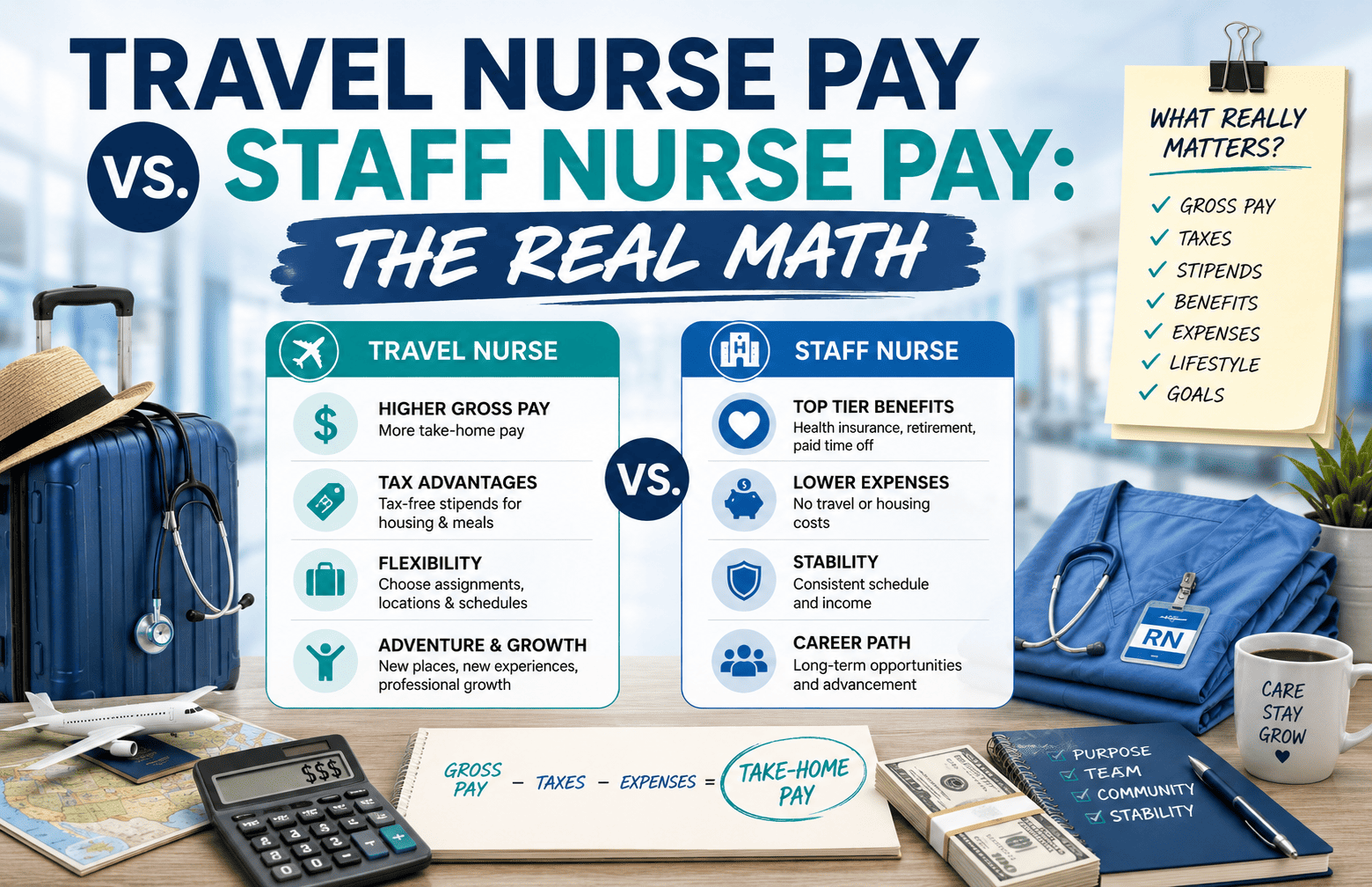
Travel nursing agencies typically show you a weekly payrate and let you draw your own conclusions. That payrate is usually accurate. However, it’s a mistake to compare that weekly payrate directly with the weekly payrate of a permanent job.
A staff job comes with a salary and a stack of benefits you rarely think about until you price them out separately: a retirement match, subsidized health insurance, paid time off, an employer who foots the bill for your ACLS renewal and so on. A travel nursing contract comes with a bigger weekly check and none, or only some, of those extras. As a travel nurse, you’re most often a 1099-adjacent worker with a W2 wrapper and funding your own safety net out of a paycheck that looks a lot larger than it actually is once you do that funding.
Neither path is a scam and neither is free money. In this article, we’ll provide the actual math, not the recruiter pitch version.
What “Pay” Actually Means for Perm and Travel Nurses
A staff nurse’s compensation has two parts: the salary, and a benefits package the employer is quietly paying for behind the scenes. Health insurance premiums, retirement matching, PTO accrual, and CE reimbursement don’t show up on your pay stub as a dollar figure, but they’re real money your employer is spending so you don’t have to.
A travel nurse’s pay package has three parts. The taxable hourly wage and non-taxable stipends for housing, meals and incidentals comprise the “weekly package” number agencies advertise.
The third part is the benefits package, and this is where things really get tricky. Some agencies advertise weekly pay that assumes they will provide zero benefits. If you end up opting into benefits from them, they reduce the weekly pay rate in kind. Other agencies advertise weekly pay that assumes they will provide some, or even all, of the benefits you’re accustomed to.
So, comparing a travel nursing pay package to a permanent pay package, or even one travel package to another, means putting everything on the same footing. Essentially, you need to account not only for the income, but also for any expenses that shift to you.
Side-by-Side Perm vs. Travel Nurse Pay: An Annual Comparison
Below is a sample breakdown using national averages, assuming the agency pays for zero benefits:
| Category | Staff RN (national average) | Travel RN (national average, zero-benefit rate) |
| Gross annual taxable pay | $88,600 (52 36-hour weeks at ~$47.32/hour, PTO paid at the same rate) | $42,300 (47 36-hour weeks at $25/hour) |
| Gross annual nontaxable lodging and M&IE stipends | not applicable | $72,700 |
| Travel expense reimbursement (agency mileage/travel pay) | $0 | +$1,000 |
| Travel and moving expenses (your actual cost to relocate between contracts) | $0 | -$1,000 |
| Employer 401k match (100% match up to 4% of salary, if she contributes at least that much herself) | +$3,500 | $0 |
| Employer health, vision and dental insurance subsidy | +$7,800 | $0 |
| Self-funded health, vision and dental insurance | -$1,950 | -$5,400 (marketplace plan, no employer subsidy) |
| Employer-paid basic life insurance | +$175 | $0 |
| Employer-paid CE and certs | +$700 | $0 |
| Self-funded CE | (covered above) | -$150 |
| Self-funded multi-state licensing | (employer typically covers) | -$650 |
| Home base housing while traveling | not applicable, one home, fully used | -$0 to -$20,000+ (depends heavily on whether you sublet, share the lease, or own vs. rent an empty home) |
| Approximate gross total value | $98,825 | ~$88,800 to $108,800 |
| Estimated approximate net total value | ~$80,255 | ~$82,800 to $102,288 |
The table above gives us a high-level overview. However, we need to dig into the nuances and gray areas in order to fully understand this comparison. Let’s look at each item separately and as they appear in the table.
Travel Nurse vs. Perm Net Pay
Note that the $115,000 travel nursing pay figure ($42,300 plus $72,700) isn’t one lump of taxable income like the perm pay figure. Instead, only about one third of the travel nurse pay is taxable. The rest is non-taxable stipend money for lodging, meals, and incidentals. That split matters for two reasons.
First, the net pay travel nurses receive is substantially higher. You can see that difference in the “Estimated approximate net total value” row at the end of the table. Simply put, we estimate that the perm employee would pay approximately $18,570 in federal and state taxes assuming they filed single in Ohio, with no dependents and made a $3,500 401k contribution. Meanwhile, the travel nurse would pay only approximately $6,512 in federal and state taxes assuming they filed single with a tax home in Ohio, no dependents, a $3,500 IRA contribution and travel assignments in California. That’s a difference of over $13,000.
However, it’s important to note that these tax-advantaged programs have some costs worth considering. For example, state disability programs, unemployment benefits, and Social Security credits are calculated off taxable wages, not total pay package value. Therefore, lower taxable wages equate to lower benefit levels. Moreover, mortgage lenders, and other lenders, typically consider only the taxable wages when determining loan limits. This is why travel nurses can have a difficult time qualifying for loans they might otherwise qualify for. However, it’s important to note that there are workarounds for this loan issue in some cases.
Perm and Travel Nurse PTO Considerations
Regarding the permanent pay package in our table above, it’s important to note that the PTO doesn’t add anything on top of a staff nurse’s $88,600 annual salary. She’s paid the same rate whether she’s clocked in or on vacation. Therefore her salary already smooths over the weeks she’s not working.
However, a travel nurse typically doesn’t have that cushion. Every week she’s not on contract, the income simply isn’t there. This is why her taxable and nontaxable pay together reflect only the 47 weeks she actually worked, not a full 52. It’s possible for travel nurses to work more or less than 47 weeks per year, so this becomes an important part of the equation.
Travel Nurse Moving Expenses
In our example above, the travel expense reimbursement and moving expense lines roughly cancel out. However, that’s not always the case. Different agencies handle such expense reimbursements in different ways. Moreover, travel expenses vary dramatically from assignment to assignment. Ultimately, you’ll need to factor these costs and reimbursements into your pay evaluation for each travel assignment.
Matching 401k Contributions
A staff job with a 100% contribution match up to 4% of salary hands you thousands of dollars a year for doing nothing but showing up and contributing. Travel nursing agencies often offer a 401k you can contribute to, but a real match is rare. Moreover, when it exists it’s usually smaller. That’s money you have to consciously replace yourself, and most travelers don’t.
Perm vs. Travel Nurse Health Insurance
In general, agency-offered health plans exist to meet ACA minimum requirements, not to compete with a hospital system’s negotiated group plan. Expect higher deductibles, narrower networks, and often no dental or vision at all. Perm employer group plans routinely bundle dental and vision into the same enrollment at low or no added cost. An individual ACA marketplace plan, which is what most self-funding travelers end up buying instead, almost never includes either. Instead, they’re separate policies you have to shop for and pay for on top of medical. The whole package would usually cost more out of pocket than the small payroll deduction a staff job charges for subsidized coverage.
Perm vs. Travel Nurse Additional Benefits
A staff job also carries a wider safety net waiting in the background even if you never touch it in a given year. According to BLS’s National Compensation Survey, 84% of RNs receive life insurance benefits, 81% of RNs receive employee wellness programs, 36% receive paid family leave, 28% receive childcare assistance, and 10% receive student loan repayment.
We listed only the life insurance benefit in our sample table above. However, you should assign a value to each of these benefits that you receive and utilize in order to accurately compare perm and travel pay packages.
Perm vs. Travel Nurse Continuing Education
Hospitals often cover unit-specific certifications, conference attendance, or tuition assistance for staff. As a traveler, ACLS, PALS, TNCC renewals, and any CE hours required to keep multiple state licenses active often come out of your own pocket. This is another benefit where some agencies offer coverage and others do not. Typically, those that offer it have lower pay than they otherwise would if they did not offer it.
Perm vs. Travel Nurse Licensing
Compact licensure has made this easier, but hasn’t eliminated it. Non-compact states still require individual licenses, often $100 to $300 each, plus renewal fees and background checks. A traveler working three or four states a year can spend several hundred dollars just staying legally eligible to work.
Travel Nurse Tax Home Duplicate Housing Expenses
Travel nurses need to maintain tax homes in order to qualify for nontaxable reimbursements. And paying duplicate housing expenses for your tax home is one component of the most common strategy for maintaining a tax home. Therefore, most travel nurses pay for housing at their assignment and for housing at their tax home, hence the “duplicate” expense.
Now, there are a number of different scenarios for paying for housing at your tax home. You might own the lodging and pay a mortgage. Or, you might own the lodging outright and pay only the taxes, insurance, utilities and maintenance. You could rent a whole unit or rent a portion of a unit.
Obviously, this is an expense that perm nurses don’t have. Therefore, you need to account for this expense in some way when you compare perm to travel pay packages.
Some travel nurses choose to treat the tax home lodging expenses as the duplicate expense while others choose to treat the assignment lodging as the duplicate expense. Those that treat the assignment lodging as the duplicate expenses are typically trying to determine how the travel nursing pay package compares to their permanent pay package. For example, if the travel pay package minus the assignment lodging expenses nets them a certain amount more than they would net from their permanent job, then they view the assignment as a good opportunity. If not, then they view the assignment as a loss. This approach is more common with those who own their homes because they’re tied to the home.
However, it’s important to note that paying a mortgage does add to the equity in the home, so it’s actually positive for your net worth. Moreover, you could sublet a portion of the home in order to reduce expenses.
By contrast, those who rent at their tax home tend to treat the tax home lodging as the duplicate expense. This is because maintaining the tax home is the only reason they are paying the rent in the first place. Moreover, those who rent are also able to come up with creative ways to minimize the rent they actually pay, like renting a room from a family member.
Understanding the Perm vs. Travel Nurse Pay Comparison
As you can see, a lot hinges on travel nurse tax advantage programs and tax homes. When all the dust settles, the tax advantage is a major boon for the travel nurse’s net pay and the tax home can be a major expense depending on your specific situation. Next, let’s walk through a specific example.
The Worked Example: One Year of Travel Nurse vs. Perm Pay
Let’s assume you’re an ICU RN with five years of experience and no dependents. Here’s what one full year might look like on each path.
One Year as a Staff RN
Our sample staff RN works three 12-hour shifts a week. That’s 1,872 hours a year. ICU gets a premium rate over the national blended average. However, at roughly 1%, it’s smaller than most nurses assume. That makes the pay roughly $48 per hour.
For 1,872 hours, that’s $89,856 in base pay, plus about $3,000 a year in night and weekend differentials, for $92,856 in gross wages. Remember, that already covers the weeks she takes as PTO, since she’s paid the same rate whether she’s on the unit or on vacation.
Meanwhile, her hospital matches 100% of her 401k contributions up to 4% of her pay which is worth $3,714. The hospital also covers about 80% of her health insurance premium. Assuming the health plan costs $9,500 per year, that’s $7,600 from the employer. That leaves $1,900 that the hospital will withhold from her pay check over the course of the year. She also gets a small group life insurance policy at no cost to her, worth about $175 a year, and her unit covers her ACLS and specialty cert renewals, worth about $700.
Total gross value: $103,145 ($92,856 + $3,714 + 7,600 – $1,900 + 175 + $700)
Total estimated net value: $83,164 ($103,145 – $19,981 in estimated taxes)
One Year as a Travel RN
Our sample travel RN also specializes in ICU. However, ICU commands a much steeper premium on the travel side than the staff side. This is because travel bill rates respond quickly to acute facility demand for hard-to-fill specialties in a way staff pay scales generally don’t. So, where her staff premium was worth about a dollar an hour, her travel premium is worth more.
As such, she lands contracts that average $2,700/week. Over the year, she completes three back-to-back 13-week contracts with short gaps between them, plus a fourth shorter contract. She ends up working 46 weeks total. Note that it’s common for travel nurses to lose work time to gaps in start dates, credentialing delays, time off and holidays.
46 weeks at $2,700 per week comes out to $124,200. Remember, unlike her staff wages, that figure only covers weeks she actually works. There’s no paid version of a week off.
Of that $124,200, roughly $45,700 is taxable wage and the remaining $78,500 is non-taxable lodging and M&IE stipends. The exact split depends on her agency and the GSA rate for each assignment’s locality.
Now let’s look at the costs. She buys her own ACA marketplace plan since she doesn’t have a spouse’s coverage to fall back on and this package includes no employer subsidy. It costs about $5,400 a year. Since it’s an individual marketplace plan, dental and vision aren’t included. She’d need to add those separately if she wants them.
She picks up two additional state licenses and covers her own recertifications for a total cost of $650. Her CE subscription to stay compliant across states is $150. Her agency also reimburses mileage each time she starts a new contract, about $1,000 across her four contracts for the year, money that roughly covers what she actually spends on gas and a hotel night driving to each new assignment, so it’s close to a wash rather than extra income. She also keeps a $900-a-month apartment back home to maintain her tax home. She’s only physically in it during her six weeks of gaps. The other 46 weeks, that rent buys her nothing, and since she’s renting rather than paying a mortgage, none of it comes back as equity. Let’s call it $8,300 of the year’s rent that is pure dead cost. All together, that’s about $14,500 in costs.
And remember, she also gets no retirement match, no employer-paid life insurance, and none of the paid family leave or childcare help her hospital counterpart has available if life circumstances change mid-contract.
Total gross value: $109,700 ($124,200 – $14,500)
Total estimated net value: $102,420 ($109,700 – $7,280 in estimated taxes assuming single filing, no dependents, a $3,500 IRA contribution, California assignments and Ohio tax home)
In this scenario, travel wins by roughly $6,500 gross and $19,200 net. That’s a real edge, but a modest one when you consider that our travel example uses $900 per month for rent on the tax home and loses access to various benefits. In fact, notice what did the damage on the cost side: not insurance, not licensing, but $8,300 in rent on an apartment she’s rarely in. If she sublet that apartment for the months she’s traveling, split the lease with a partner, or bought instead of rented and let a mortgage build equity instead of burning cash, her advantage would grow significantly over staff pay. That’s the real lever in this math, and it’s the one most pay package comparisons never mention.
Run the same nurse through more gap weeks, a lower-paying specialty, or a market correction year, and even this modest edge can reduce.
Who Travel Nursing Actually Suits
With all this in mind, let’s look at who travel nursing typically suits. It suits nurses without dependents who need school stability, or with a partner whose benefits can absorb the volatility. It suits high-demand specialties, ICU, ER, OR, L&D, Cath Lab, where the pay premium is largest and assignments string together without long gaps. It suits people genuinely energized by new units and new cities every three to six months. It suits nurses with the ability to exhibit flexibility with their living arrangements. And it suits nurses with a specific financial goal and timeline, like paying off debt or saving for a down payment, where a few years of substantially higher net pay gets them there faster than a staff salary would.
Who Travel Nursing Doesn’t Suit
It doesn’t suit nurses who need predictable income to qualify for a mortgage because many lenders want two years of travel income history before they’ll count it fully. It doesn’t suit single parents or families who need consistent schools and childcare. It doesn’t suit anyone managing a chronic condition who relies on continuity of care, since networks reset with every assignment. It doesn’t suit new grads because most travel jobs require one to two years of experience. Finally, it doesn’t suit specialties or regions where the pay premium is thin.
Is Travel Nursing Dying? Where the Market Actually Stands in 2026
If you’ve been in a break room in the past year, you’ve probably heard some version of “travel nursing is dead.” The data doesn’t support that, but it doesn’t support a return to 2022 either.
Travel nurse industry revenue grew from $8.7 billion in 2019 to a pandemic peak of $44.6 billion in 2022, according to Staffing Industry Analysts (SIA). That peak was never going to hold because crisis-rate contracts were a temporary response to an acute shortage caused by the pandemic. Revenue corrected hard after that. SIA’s 2026 benchmarking data shows aggregate revenue declining roughly 12% in 2025, landing around $14.2 billion, driven mainly by lower assignment volume rather than falling pay.
Bill rates themselves have largely stabilized. SIA reports the aggregate travel nurse bill rate came in at $90.54 in 2025, essentially flat versus $90.13 in 2024. What’s changed is fewer crisis-rate contracts and more competition for the assignments that exist. Analysts project growth to return in 2026 as the market finds its footing.
Keep the correction in perspective, too. Even after a steep pullback from the pandemic peak, the market remains roughly 63% bigger than 2019 by revenue. Only about 5% of the country’s 3.5 million actively practicing RNs work travel assignments at any given time, which argues against both extremes you’ll hear: it’s not a niche about to vanish, and it’s not a gold rush available to everyone regardless of specialty.
The honest read is that travel nursing isn’t dying, it’s normalizing. The math above is what “normal” looks like, a real premium for the right nurse in the right specialty, not a guaranteed windfall for anyone with an RN license and a suitcase.
The Real Math, in Short
Travel nursing can pay meaningfully more than staff work, but only once you’ve accounted for the tax advantage and replaced everything a staff job was quietly giving you: insurance, retirement contributions, PTO, and CE. Do that math before you sign, not after your first tax season as a 1099-adjacent worker. Specialty, location, and how you handle your home base matter more to your actual annual net pay than the number on a job posting.
If you’re running these numbers for your own specialty and situation, a recruiter who will walk through the full package with you, not just the headline weekly number, is worth more than an extra fifty cents an hour somewhere else. BluePipes ranked Stability Healthcare the #1 travel nursing company in the country for 2026, based on nearly 230,000 clinician reviews, largely on the strength of recruiters who do exactly that kind of straight talk. That’s the conversation worth having before you compare a single weekly number against your current paycheck.