Travel nurses often receive compensation in ways that look very different from a traditional staff nurse paycheck. For example, a travel nurse contract might include a relatively modest taxable hourly wage as well as thousands of dollars per month in housing, meals, and incidental stipends. Those stipends may be tax-free, which can make the travel assignment considerably more lucrative. However, “may be” matters.
A travel nursing agency can’t just label part of your paycheck a stipend and make it tax-free, even if they pay it to you tax-free and tell you it’s tax-free. Instead, the tax treatment depends on whether you are legitimately traveling away from your tax home for a temporary work assignment and whether the reimbursement arrangement meets federal tax requirements.
If you get those pieces right, then tax-free stipends are a legitimate part of travel nursing compensation. If you get them wrong, then money you thought was tax-free could actually be taxable income.
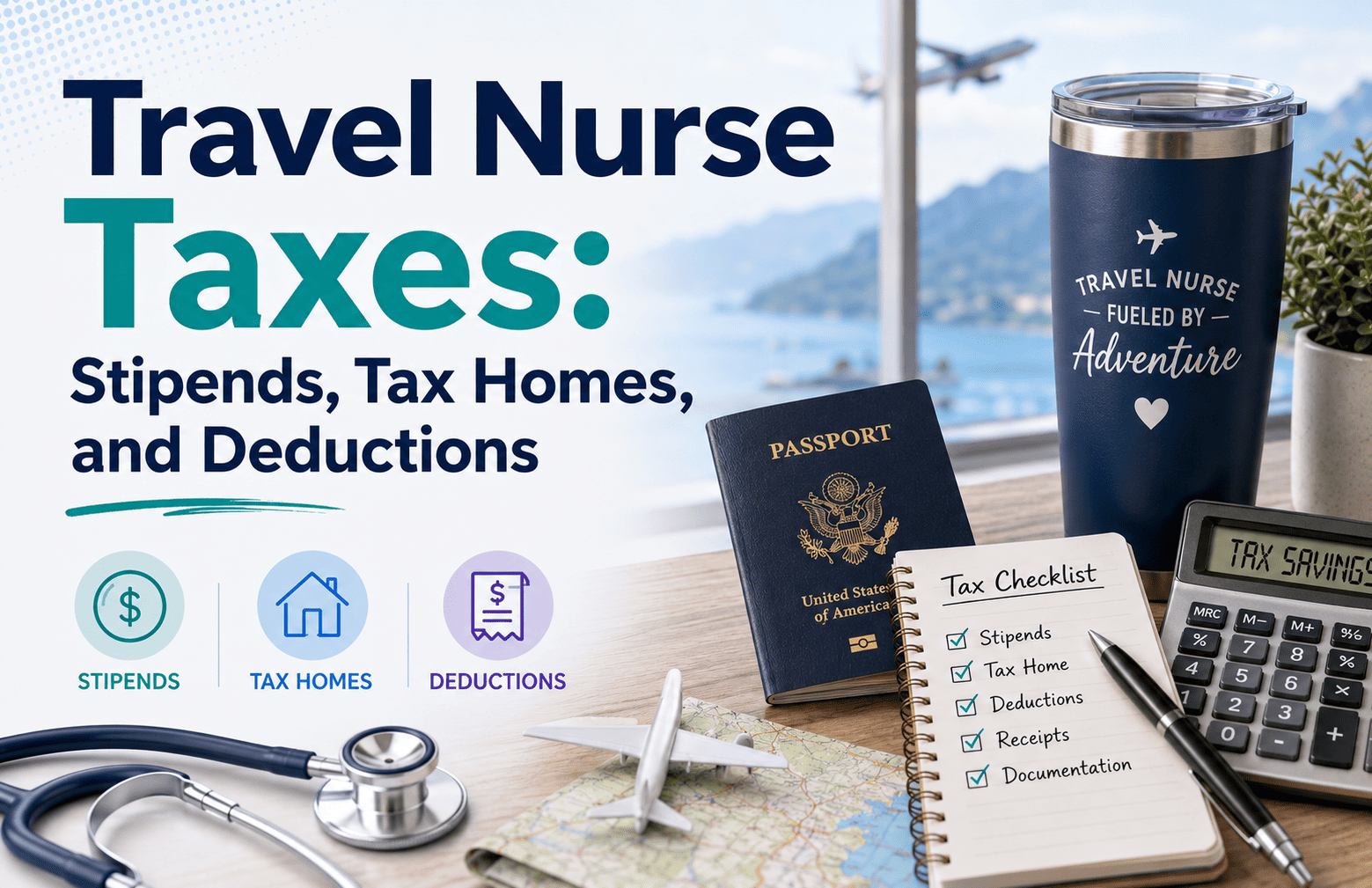
So, this article explains how travel nurse stipends, tax homes, the 12-month rule, and deductions work under federal tax rules.
Important disclaimer: This article is for general informational purposes only and is not tax, legal, or accounting advice. Individual circumstances vary, and tax laws and IRS guidance can change. Consult a qualified tax professional about your specific situation.
How Agencies Pay Travel Nurses Tax Free
Most travel nurses working for staffing agencies are W-2 employees of the agencies. Their compensation generally has two categories:
Taxable compensation: Your hourly wage, overtime, bonuses, and other taxable wages are generally subject to federal income tax, Social Security and Medicare taxes, and applicable state and local taxes.
Tax-free reimbursements or stipends: These are reimbursements for expenses such as lodging and meals while traveling away from your tax home on a temporary work assignment. You may exclude them from taxable wages when you and they meet all IRS requirements.
This second category is what makes travel nurse pay packages unusual. For example, suppose a travel nurse receives:
- $1,200 per week in W2 wages that your employer withholds taxes for accordingly
- $1,500 per week for housing, meals, and incidentals stipends that your employer does not withhold taxes for
Are Travel Nurse Stipends Taxable?
Now, just because an employer pays you tax free does not automatically mean that the IRS approves. In this example, the $1,500 can qualify as nontaxable only if the underlying arrangement and the nurse’s circumstances meet the IRS’s requirements. So, both the agency and the nurse have rules they each need to follow.
The IRS requires agencies to maintain what it refers to as an “accountable plan” in order to provide nontaxable reimbursements. There are different types of accountable plans that employers can follow. Most, if not all, travel nursing agencies follow plan rules that allow them to reimburse in amounts up to the maximum that the federal government’s General Services Administration (GSA) allows for lodging, meals and incidentals. Additionally, they can reimburse only for qualifying business travel expenses the employee incurs while working temporarily away from their tax home. There are a host of other rules agencies must follow as well, but those are the main ones.
As a travel nurse, the main rules you need to follow when it comes to qualifying for nontaxable stipends are those that pertain to maintaining a tax home. Because if you don’t have a qualifying tax home, or your assignment has become indefinite rather than temporary, nontaxable reimbursements that would otherwise qualify as nontaxable can become taxable compensation. In fact, the IRS specifically states that when a work assignment is indefinite, employer-paid living expenses generally must be included in wages. Moreover, when you don’t have a tax home at all, the IRS considers you an “itinerant worker” which means that you don’t qualify for nontaxable reimbursements at all.
So, let’s drill down to understand tax homes.
What Is a Travel Nurse Tax Home?
Your travel nurse tax home is not necessarily the place you consider home. This distinction causes a lot of confusion.
For tax purposes, the IRS generally defines your tax home as your regular or main place of business or employment, which can be different from where your family lives or where you maintain a permanent residence. If you regularly work in multiple places, factors such as how much time you spend working in each location, the level of business activity, and the financial return from each location can help determine your main place of business.
Travel nursing makes this more complicated because many travelers don’t have one permanent hospital where they regularly work.
When you don’t have a regular or main place of business, the IRS looks at additional facts and circumstances, including whether you incur duplicate living expenses while traveling and whether you maintain and regularly use a residence elsewhere. If you have neither a regular place of business nor a place where you regularly live, then the IRS might classify you as an itinerant or transient worker. In that situation, wherever you work is effectively your tax home, meaning you are never traveling “away from home” for purposes of the travel-expense rules.
That’s why simply using your parents’ address, keeping a driver’s license in one state, or receiving mail somewhere does not automatically establish a tax home.
The Basic Idea: You Need a Home to Travel Away From
A useful way to understand the tax-home concept is through duplicated expenses.
Imagine you maintain an apartment in Denver and pay $1,700 per month in rent. You accept a 13-week assignment in Seattle and rent furnished housing there for another $2,300 per month.
You are paying to maintain your life in Denver while also incurring additional living expenses because your job temporarily requires you to be in Seattle.
That is the basic economic situation the travel-expense rules are designed to address.
Now consider a different nurse.
She leaves her apartment, puts everything in storage, travels from contract to contract, and has no residence she financially maintains elsewhere. She uses her parents’ address for mail and her driver’s license but doesn’t pay meaningful household expenses there.
Calling the parents’ house her “permanent address” does not necessarily make it her tax home.
She may instead be considered an itinerant worker. If so, each place she works becomes her tax home, and she isn’t considered to be traveling away from home for purposes of qualifying travel expenses.
That distinction can potentially turn thousands of dollars in supposedly tax-free stipends into taxable income.
What Helps Establish a Travel Nurse Tax Home?
There is no magic document that creates a tax home. The IRS looks at the actual facts.
For travelers without one obvious primary workplace, relevant facts can include maintaining a residence in the area you consider home, paying legitimate expenses associated with that residence, duplicating living expenses while on assignment, regularly returning to the residence, and having meaningful personal or business connections to the area.
The IRS has historically described three factors for workers without a regular main workplace: whether they conduct business in the area of their main home, whether they duplicate living expenses while traveling, and whether they have abandoned the area where they historically lived and worked. The IRS also looks at whether the taxpayer maintains and uses the home for lodging.
The important lesson is that paper connections are weaker than economic reality.
Keeping a voter registration, driver’s license, bank statement, or mailing address in a state can help document your ties. But those things don’t substitute for actually maintaining a legitimate home when the underlying tax rules require one.
What Can Break a Travel Nurse Tax Home?
Problems often arise when a traveler:
- Gives up their permanent residence and moves continuously from assignment to assignment.
- Claims a relative’s house as a tax home while contributing little or nothing toward maintaining the household.
- Stops returning to or maintaining meaningful connections with the claimed home area.
- Works so extensively in one assignment location that it becomes their new tax home.
- Accepts an assignment that is realistically expected to last more than one year.
The last issue is particularly important because of what is commonly called the 12-month rule.
The 12-Month Rule for Travel Nurses
Travel nurses often hear some version of:
“You can’t stay in the same city for more than 12 months.”
That’s directionally useful, but the actual concept is more nuanced.
The IRS distinguishes between temporary and indefinite work assignments.
An assignment in a single location is generally temporary if it is realistically expected to last, and actually does last, for one year or less. If the assignment is realistically expected to last for more than one year, then the IRS considers it indefinite.
When an assignment becomes indefinite, the assignment location generally becomes your tax home. At that point, your lodging and meals there are no longer qualifying expenses of traveling away from your tax home.
Notice that this rule is based partly on expectation, not simply the number of days that eventually pass.
Suppose you accept a nine-month assignment. After eight months, the hospital asks you to extend for another seven months.
The IRS gives essentially this exact example in Publication 463. The assignment initially qualifies as temporary because the worker reasonably expected it to last nine months. Once circumstances change and the worker expects to remain beyond one year, however, the assignment becomes indefinite. The travel expenses stop qualifying from the point that expectation changes, not merely on day 366. That is an important distinction for travelers who repeatedly extend contracts.
Does Leaving for 30 Days Reset the 12-Month Clock?
You will undoubtedly come across supposed rules like, “Leaving your assignment location for 30 days resets the 12-month clock.” Be very careful with supposed rules of thumb like this.
There is no universal IRS rule saying that leaving an area for 30 days, six weeks, or some other magic period automatically resets everything.
Again, the IRS looks at the overall facts and circumstances. Publication 463 specifically warns that a series of short assignments in the same location that collectively covers a long period can constitute an indefinite assignment.
Consider this sequence for example:
13-week assignment → short break → another assignment → short break → another assignment
This doesn’t necessarily allow you to work indefinitely in the same location while continuing to receive tax-free travel reimbursements. The issue is whether the work in that location remains genuinely temporary. This is exactly the kind of gray area where relying on travel-nurse folklore can become expensive.
What Travel Nurse Expenses Are Deductible?
Deductibles have changed significantly over the years, and outdated travel nursing tax articles can be misleading. For most W-2 travel nurses, the answer today is surprisingly simple:
You generally cannot take a federal income-tax deduction for ordinary unreimbursed employee business expenses.
Federal law disallows the miscellaneous itemized deduction that employees once commonly used for unreimbursed work expenses, subject to limited exceptions that generally don’t apply to travel nurses. That restriction has now been made permanent.
That means a typical W-2 travel nurse generally cannot personally deduct unreimbursed costs such as:
- Scrubs and other work clothing
- Nursing equipment
- Licensing expenses
- Continuing education
- Travel to an assignment
- Housing while on assignment
- Meals while traveling
- Professional dues
- Unreimbursed mileage
Simply having a legitimate work-related expense does not mean a W-2 employee gets a federal tax deduction for it. This is one reason the reimbursement structure offered by a travel nursing agency matters so much.
Reimbursements and Deductions Are Not the Same Thing
Specifically, reimbursements and deductions are not the same thing. This distinction is worth emphasizing.
Suppose your agency properly reimburses qualifying travel expenses under an accountable plan.
The benefit isn’t necessarily that you take a deduction on your tax return. Instead, the qualifying reimbursement may be excluded from taxable wages in the first place. That’s often much more valuable and much simpler.
The IRS allows employers to use qualifying per diem arrangements for travel expenses. When the employer and employee meet all applicable requirements and allowances do not exceed the relevant federal rates, the per diem can satisfy certain expense-substantiation requirements without the employee having to prove every dollar of actual spending. The employee still generally must substantiate facts such as the dates, location, and business purpose of the travel.
This explains a common misconception about stipends. That is, you don’t necessarily need to spend every dollar of a properly structured per diem allowance for it to receive favorable tax treatment.
The rules governing qualifying per diem allowances are different from simply handing an employee extra wages and calling them “housing money.”
What If You’re a 1099 Nurse?
However, the rules can be substantially different for genuinely self-employed clinicians. A self-employed taxpayer can generally deduct ordinary and necessary business expenses on Schedule C, including qualifying business travel expenses. Those can include transportation, lodging, certain vehicle expenses, laundry while traveling, business communications, and generally 50% of qualifying business meals.
However, you’re not automatically an independent contractor in the legal sense just because someone reports their payments to you on a form 1099. Instead, worker classification depends on the actual working relationship.
Most traditional travel nurses working through staffing agencies are W-2 employees and/or don’t qualify as independent contractors. Therefore, don’t assume that Schedule C rules apply simply because another traveler told you they “write everything off.”
State Taxes Add Another Layer
It’s important to remember that Federal tax rules are only part of the picture. Travel nurses routinely work in states other than their state of residence. That can create filing obligations in multiple states.
Depending on the states involved, you may need to file a resident return in your home state and a nonresident return in the state where you worked. States often provide mechanisms such as credits for taxes paid to another state to reduce double taxation, but the details vary.
Some states have reciprocal agreements. Others don’t. And a handful of states have no individual state income tax on wages.
This factor becomes especially complicated when you work assignments in several states during the same calendar year. Three or four W-2s involving multiple states is a good point at which tax software’s promise to make everything effortless starts becoming less possible.
Records Travel Nurses Should Keep
As we’ve mentioned multiple times in this article, it’s important to keep your own set of records in case you need them to justify the nontaxable reimbursements. Even if your agency handles the reimbursement side correctly, keep your own records.
Useful documentation can include leases or mortgage records for your permanent residence, utility bills, records of household expenses, assignment contracts, temporary housing agreements, receipts, travel records, mileage logs where applicable, and records showing when you returned home.
The IRS emphasizes the importance of maintaining records supporting travel expenses and reimbursements. You may never need them. But if anyone questions your tax home or stipend treatment several years later, reconstructing where you lived, where you worked, what you paid, and when you traveled is considerably harder than saving the documentation as you go.
When Should a Travel Nurse Hire a Tax Professional?
Not every traveler needs a CPA. If you worked one straightforward assignment, maintained an obvious tax home, received W-2 wages, and have simple state filings, mainstream tax software may be perfectly adequate.
Professional help becomes much more worthwhile when your situation isn’t clean.
Consider talking to a CPA, enrolled agent, or other qualified tax professional if:
- You’re uncertain whether you actually have a tax home.
- You don’t maintain your own apartment or house at your permanent location.
- You share housing with parents, relatives, or friends.
- You have worked repeatedly in the same metropolitan area.
- You’re approaching a year in one assignment location.
- You’ve taken repeated extensions.
- Your agency is treating a large percentage of your compensation as tax-free.
- You worked in several states during the year.
- You received both W-2 and 1099 income.
- You’re considering operating as an independent contractor or through a business entity.
- An agency’s explanation of its stipend structure doesn’t make sense to you.
- You’re being audited or have received a notice from the IRS or a state tax authority.
And ideally, get advice before making the questionable move.
Asking a tax professional in November whether another extension will affect your tax home is much more useful than asking the following April after you’ve already accepted the extension and received months of stipends.
Look for someone who actually understands temporary work assignments and mobile healthcare professionals. A preparer who handles only conventional W-2 households may be excellent at taxes generally while having little experience with travel healthcare.
Don’t Let the Tax-Free Stipend Drive the Entire Decision
Tax-free reimbursements are one of the genuine financial advantages available to qualifying travel nurses. But they sometimes distort the way travelers evaluate contracts.
A pay package with a very low taxable hourly rate and large stipends can produce attractive take-home pay, but taxable wages matter too. They can affect Social Security earnings, unemployment benefits, workers’ compensation calculations, retirement contributions, borrowing qualifications, and other financial considerations.
More importantly, tax-free treatment is not something you get simply because you’re a “travel nurse.” The underlying rules still apply. You need a legitimate basis for being treated as traveling away from your tax home. The assignment needs to remain temporary. The expenses and reimbursement arrangement need to qualify. And your actual circumstances need to support what is being reported.
The Bottom Line on Travel Nurse Taxes
The easiest way to understand travel nurse taxes is to stop thinking of stipends as a special tax break created for travel nurses. They aren’t. The tax rules apply to all workers who temporarily travel away from their tax homes for business. Travel nurses simply encounter those rules more often because temporary assignments are the nature of the job.
A legitimate travel nurse tax home generally requires more than a mailing address. Your work and living arrangements need to support the claim that you have a home from which you are temporarily traveling, and travelers without a qualifying tax home can be treated as itinerant workers.
The one-year rule matters because an assignment that becomes indefinite can turn the assignment location into your new tax home. And short breaks between contracts do not automatically reset that determination.
Finally, if you’re wondering “are stipends taxable?”, remember that the word stipend doesn’t decide anything. A qualifying reimbursement for legitimate temporary business travel can be excluded from taxable wages. A payment that doesn’t meet the requirements can be taxable compensation regardless of what the pay package calls it.
Travel nursing taxes don’t have to be intimidating. But they’re also not an area where you want to build your financial plan around something another traveler said in a Facebook group.
When the facts get complicated, pay someone who understands the rules to look at your actual situation. That’s considerably cheaper than finding out later that the IRS sees your tax home differently than you did.
This article is provided for general informational and educational purposes only and does not constitute tax, legal, or accounting advice. Tax rules vary based on individual circumstances and can change. Consult a qualified tax professional regarding your specific situation.