California is one of the most popular destinations for travel nurses. The state consistently offers some of the highest travel nursing pay in the country, along with strong nurse-to-patient ratio protections and assignments everywhere from major Los Angeles medical centers to smaller hospitals along the Central Coast. However, getting licensed can be a bear.
If you already hold an RN license in another state, you will generally apply for a California RN license by endorsement through the California Board of Registered Nursing (BRN). The process is manageable. However, California has a reputation for taking longer than many states, and small mistakes can turn a straightforward application into a months-long struggle.
So, here we’ll cover how to get a California nursing license, what it costs, how long it realistically takes, and what travel nurses can do to avoid the most common delays.
Does California Participate in the Nurse Licensure Compact?
No. California is not currently a member of the Nurse Licensure Compact (NLC).
That means a multistate nursing license issued by another compact state does not give you authority to practice in California. If you want to take a travel nursing assignment in California, you need a California RN license. If you are already licensed as an RN in another U.S. state or territory and meet California’s requirements, you can apply for licensure by endorsement.
How to Get a California Nursing License by Endorsement
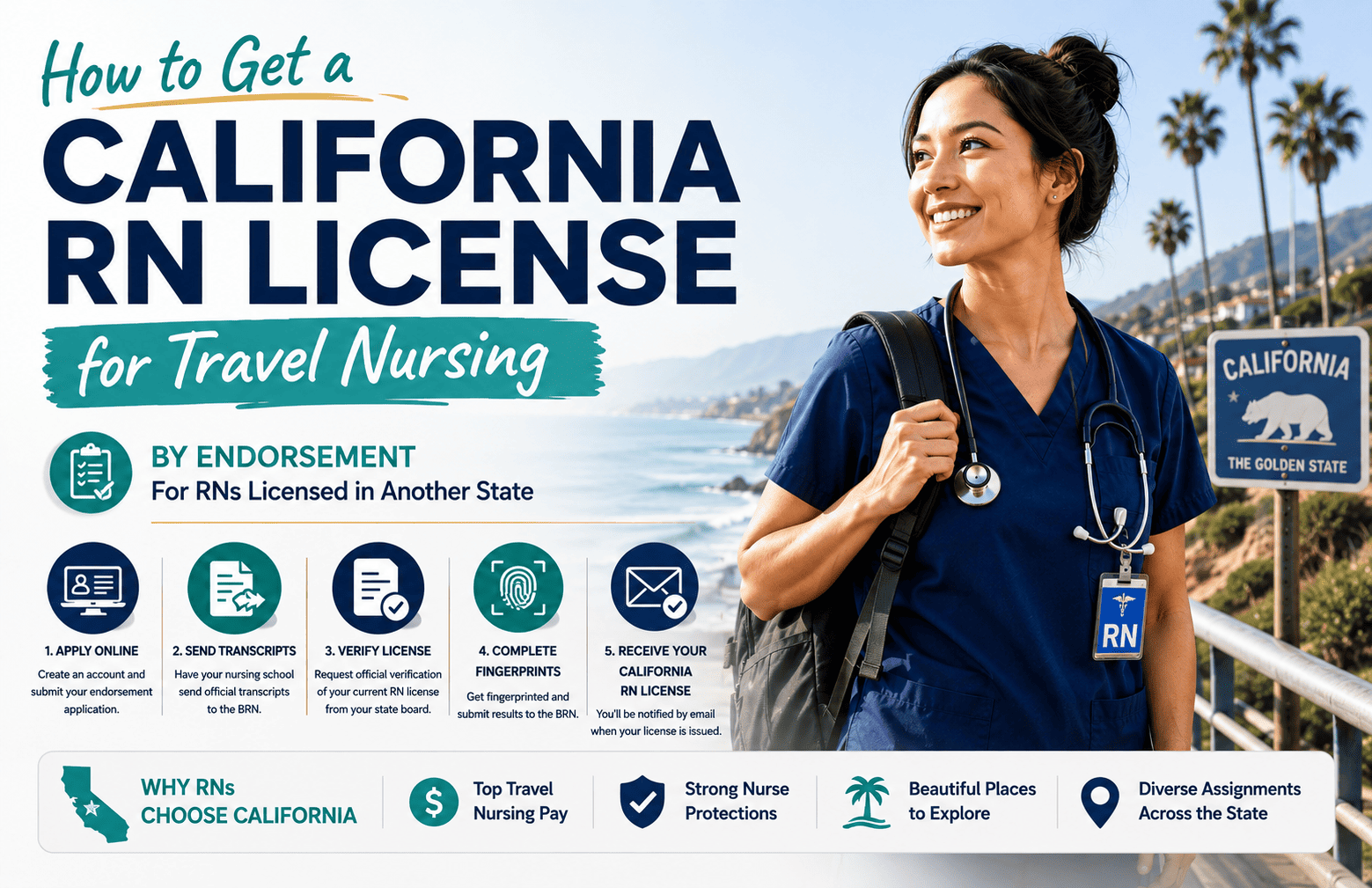
The California BRN recommends applying online through its BreEZe licensing system. Here are the basic components of that process:
- Submit the endorsement application
- Verification of your existing RN license
- Provide your nursing school transcripts
- Complete fingerprints
- Wait for the BRN to review the complete file.
For a travel nurse, the most important thing to understand is that these pieces can move independently. Submitting the online application does not mean your application is complete. Your school, another board of nursing, a fingerprinting agency, and the BRN may all be involved before the BRN issues your license. So, let’s unpack each of the components above.
Step 1: Create a BreEZe Account and Submit Your Endorsement Application
Start with the California Department of Consumer Affairs’ BreEZe system. Create an account if you do not already have one, then select RN Endorsement under the option to start a new application.
You will provide personal information, education and licensing history, and answer questions about disciplinary and criminal history.
The application fee for a U.S.-educated RN applying by endorsement is currently $350. For an internationally educated RN, the endorsement application fee is $750.
Complete this application carefully. Names, previous names, license information, education dates, and other details should exactly match the supporting documentation that BRN will receive.
Step 2: Send Your Nursing School Transcripts
California needs to verify that your nursing education meets its licensing requirements.
For nurses educated at an out-of-state U.S. nursing program, official transcripts can be sent electronically to the BRN by approved electronic transcript services such as Parchment or National Student Clearinghouse, or directly by the nursing school.
Do not assume your transcript automatically follows you because you are already licensed elsewhere.
This is one of the areas where applicants get into trouble. You can submit everything on your end while your application remains incomplete because the BRN has not received an acceptable transcript.
Travel nurse tip: Be ready to request your transcript immediately after submitting your application, then verify that the school or transcript service actually sent it. Keep the confirmation.
Internationally educated nurses face additional educational documentation requirements and should expect the process to be more complicated.
Step 3: Verify Your Existing RN License
The BRN also needs official verification of your existing RN license.
If the applicable state board participates in Nursys, you can generally request electronic verification through Nursys. California specifically requires an official verification, not a Nursys QuickConfirm lookup. If the appropriate board does not participate in Nursys verification, you will need to follow that board’s process for sending verification directly to California.
Do this early. License verification is another part of the application that depends on an outside organization. The faster you initiate it, the less likely you are to discover weeks later that California is waiting for something you thought had already arrived.
Step 4: Complete Your Fingerprints
Every California RN applicant must undergo state and federal criminal history checks.
You have two options.
Option 1: California Live Scan
Live Scan is the faster option, but there is a catch that matters for travel nurses living outside California:
The Live Scan must be performed in California.
A Live Scan performed in another state cannot be used for this California BRN requirement. The BRN identifies California Live Scan as its preferred and quickest fingerprint method. Results are often visible in BreEZe within about 72 hours, although the BRN advises that results can take a couple of weeks.
If you live reasonably close to California, are visiting the state, or are already there between assignments, getting a California Live Scan can eliminate one of the biggest potential bottlenecks in the process.
Option 2: Fingerprint Hard Card
Nurses outside California can instead use an FD-258 fingerprint card.
You have your fingerprints rolled by an appropriate local agency, such as a police or sheriff’s department, and mail the completed card to the BRN for processing.
The BRN charges a $49 manual fingerprint processing fee. More importantly, hard-card fingerprint processing can take substantially longer. The BRN warns that processing times vary and can take up to 90 days on average in some circumstances.
That makes fingerprints a potentially major issue for a travel nurse trying to get licensed quickly.
If you know you want to work in California, don’t wait until you find the perfect assignment before dealing with this.
Step 5: Consider Applying for a Temporary California RN License
California offers a temporary RN license to nurses applying by endorsement.
The temporary license costs an additional $100 and is valid for six months while your permanent application is pending. You first submit the endorsement application, then request the temporary license through your BreEZe account.
This can be extremely useful for travel nurses.
As of July 2026, the BRN listed its processing timeframe for a U.S. endorsement application at 10 to 12 weeks, while temporary licenses were running approximately 2 to 3 weeks.
There is an important caveat: a temporary license isn’t a workaround for incomplete fingerprints. The BRN must receive and process your DOJ and FBI fingerprint results before issuing the temporary license.
So if speed matters, requesting a temporary license while immediately completing California Live Scan can be a much better strategy than relying on a mailed fingerprint card.
How Long Does a California RN License Take?
This is where travel nurses need to separate the official processing timeframe from the best-case scenario.
As of the BRN’s July 21, 2026 update, California reported:
| Application | Current BRN timeframe |
| U.S. RN license by endorsement | 10–12 weeks |
| Temporary RN license | 2–3 weeks |
| Military endorsement | 1–2 weeks |
Those numbers change with the BRN’s workload, so always check the current processing-time page rather than assuming today’s timeframe will still apply when you submit.
There is also an important nuance. BRN data presented in 2026 showed an average processing time of about 48 days for approved U.S. endorsement applications during fiscal year 2025-26, excluding periods when applications were deficient.
That distinction matters.
A clean application can move considerably faster than a problem application. Once the BRN identifies a deficiency, the clock effectively becomes much less predictable because you’re waiting for the missing item to be corrected, received, matched to your application, and reviewed.
For travel nursing purposes, do not build your plans around the best-case timeline.
If California is on your travel nursing wish list, start licensing several months before you actually need the license.
The Most Common California RN License Delays, and How to Avoid Them
This is arguably more important than the application instructions themselves.
California processes thousands of applications. You want yours to have everything in its right place at its right time. Here are the problems commonly interfere with that.
1. Waiting to Send Transcripts
Submitting your BreEZe application is only one part of the process.
Your official nursing school transcripts still need to reach the BRN in an acceptable format.
Avoid the delay: Request transcripts immediately and save your delivery confirmation. Don’t assume the school sent them simply because you submitted a request.
2. Waiting on License Verification
The same principle applies to your out-of-state RN license verification.
Avoid the delay: Request the required verification at the beginning of the process. If using Nursys, make sure you’re requesting the official verification California requires, not simply looking yourself up through QuickConfirm.
3. Using Hard-Card Fingerprints When Live Scan Is Practical
For a nurse in New York or Florida, flying to California solely to get fingerprinted probably doesn’t make sense.
But if you’re going to be in California anyway, Live Scan can be a major advantage. Hard-card processing introduces mailing time, potentially lengthy fingerprint processing, and even smudging the fingerprints rendering them unusable.
Avoid the delay: If practical, complete Live Scan while physically in California. Remember that an out-of-state Live Scan does not count.
4. Waiting Until You Find a California Travel Assignment
This may be the biggest strategic mistake.
A recruiter finds you a great California job starting in four weeks. You apply. The hospital wants someone who can start quickly.
Then you discover that the permanent California endorsement process is currently running 10 to 12 weeks.
That’s a bad position to be in.
Avoid the delay: If there is a realistic chance you’ll travel in California within the next year, consider getting licensed before you start shopping for an assignment. Having the license already active removes a major obstacle when a good California job opens.
5. Assuming a Temporary License Is Automatic
Paying the additional $100 doesn’t guarantee you’ll have a temporary license a few days later.
The BRN still needs to process required fingerprint results, and criminal history, disciplinary issues, or other potential grounds for denial can delay issuance.
Avoid the delay: Treat the temporary license as an expedited path for an otherwise clean application, not as a way around missing documentation or background-review requirements.
6. Not Checking Your Application Status
You don’t need to contact the BRN every few days. In fact, the Board specifically discourages status inquiries while an application remains within its published processing timeframe.
But you should monitor your BreEZe account and the BRN’s Application Status and Details system.
There is a difference between patiently waiting for processing and spending eight weeks waiting on an application that has been missing a transcript since day one. The BRN’s Application Status and Details system will provide you with these details as they are available, so stay on top of it to avoid delays.
How Much Does a California RN License Cost?
For a typical U.S.-educated travel nurse applying by endorsement, the core California fees are:
| Expense | Cost |
| RN endorsement application | $350 |
| Temporary RN license, optional | $100 |
| Hard-card fingerprint processing, if used | $49 |
| Live Scan | Varies by provider |
| Transcript fee | Varies by school/service |
| License verification | Varies |
That means the BRN portion of a straightforward U.S. endorsement application starts at $350.
If you request a temporary license, you’re at $450, before any transcript, verification, or Live Scan charges.
If you’re applying from outside California using a hard fingerprint card, the BRN application plus hard-card processing comes to $399, or $499 if you also request the temporary license.
Internationally educated nurses currently pay a substantially higher $750 endorsement application fee.
Also remember that application fees are nonrefundable.
Should Travel Nurses Get a California License Before Looking for Jobs?
If you’re serious about eventually working in California, then it’s usually best to secure your California RN license before you start looking for jobs.
California is different from a compact state where you can see a job today and potentially be ready to practice almost immediately under a multistate license. Licensing can become part of the lead time required for the assignment.
You don’t necessarily need a California license simply because you might someday work there. The application isn’t cheap, and maintaining licenses you never use costs money.
But once California becomes a genuine target, applying proactively makes sense.
Hospitals and hiring managers know that the Clifornia RN licensing process can take time. A hospital choosing between two similarly qualified travel nurses may not be willing to wait months for one candidate’s license when another candidate already has an active California RN license. This reality can affect securing a job as well as an interview.
A Practical California Licensing Timeline for Travel Nurses
If your goal is to make the process as painless as possible, a reasonable approach looks like this:
Day 1: Submit your online RN endorsement application through BreEZe.
Days 1–3: Request your official nursing school transcripts and RN license verification.
As soon as possible: Complete fingerprints. Use California Live Scan if practical.
At application: Consider paying for the temporary license if you expect to pursue California assignments before the permanent license is likely to arrive.
Weeks 1–3: Monitor BreEZe and application status to make sure required documentation and fingerprint results are being received.
Weeks 2–3: A straightforward temporary license may be issued around this timeframe based on current BRN processing estimates.
Weeks 10–12: The permanent endorsement application falls within the BRN’s current published processing window for U.S. applicants.
Those are planning estimates, not promises. California’s processing times fluctuate, and an incomplete or complicated application can take longer.
Bottom Line
Getting a California RN license as a travel nurse isn’t particularly difficult, but it rewards preparation.
The biggest mistake is treating licensing as something to deal with after you’ve found a California assignment. Between transcripts, license verification, fingerprints, and BRN processing time, a preventable delay can cost you a job.
Start early. Submit your outside documents immediately. Use California Live Scan when practical. Monitor your application for deficiencies. And if you need to work before the permanent license is likely to arrive, consider the temporary-license option.
Once the license is in hand, you can pursue California assignments without having licensing become the thing standing between you and the job.
For travel nurses who want more control over that process, Stability Healthcare combines a self-service platform for searching assignments with access to real recruiters when you need help. You can explore opportunities nationwide, compare your options, and decide which assignments actually make sense for you.