Hawaii RN License by Endorsement Guide
Thinking about working in Hawaii? Whether you’re eyeing a travel assignment in Honolulu, a permanent move to the islands, or just want the option in your back pocket, this guide walks you through how to get a Hawaii RN license by endorsement — what it costs, how long it takes, and the steps that actually move your application forward.
One thing to know up front: Hawaii is not a member of the Nurse Licensure Compact (NLC). A multistate compact license from another state does not let you practice in Hawaii. Every out-of-state nurse needs a Hawaii-specific license before working in the state, which is exactly where endorsement comes in.
Can I Get a Hawaii RN License Without a Job?
Yes. You do not need a Hawaii job offer to apply for a permanent Hawaii RN license by endorsement. In fact, most nurses get licensed first and then apply for jobs, since many Hawaii employers expect you to already hold (or be close to holding) an active license before they’ll move forward.
The only pathway that requires an employer is the temporary permit — more on that below.
Estimated Cost
|
Item |
Estimated Cost |
|---|---|
|
Hawaii RN License by Endorsement |
$166 or $234 (see note) |
|
Nursys License Verification |
~$30 |
|
Fingerprinting / Background Check (Fieldprint) |
~$52 |
|
NPDB Self-Query |
~$4 |
|
Total Expected Cost |
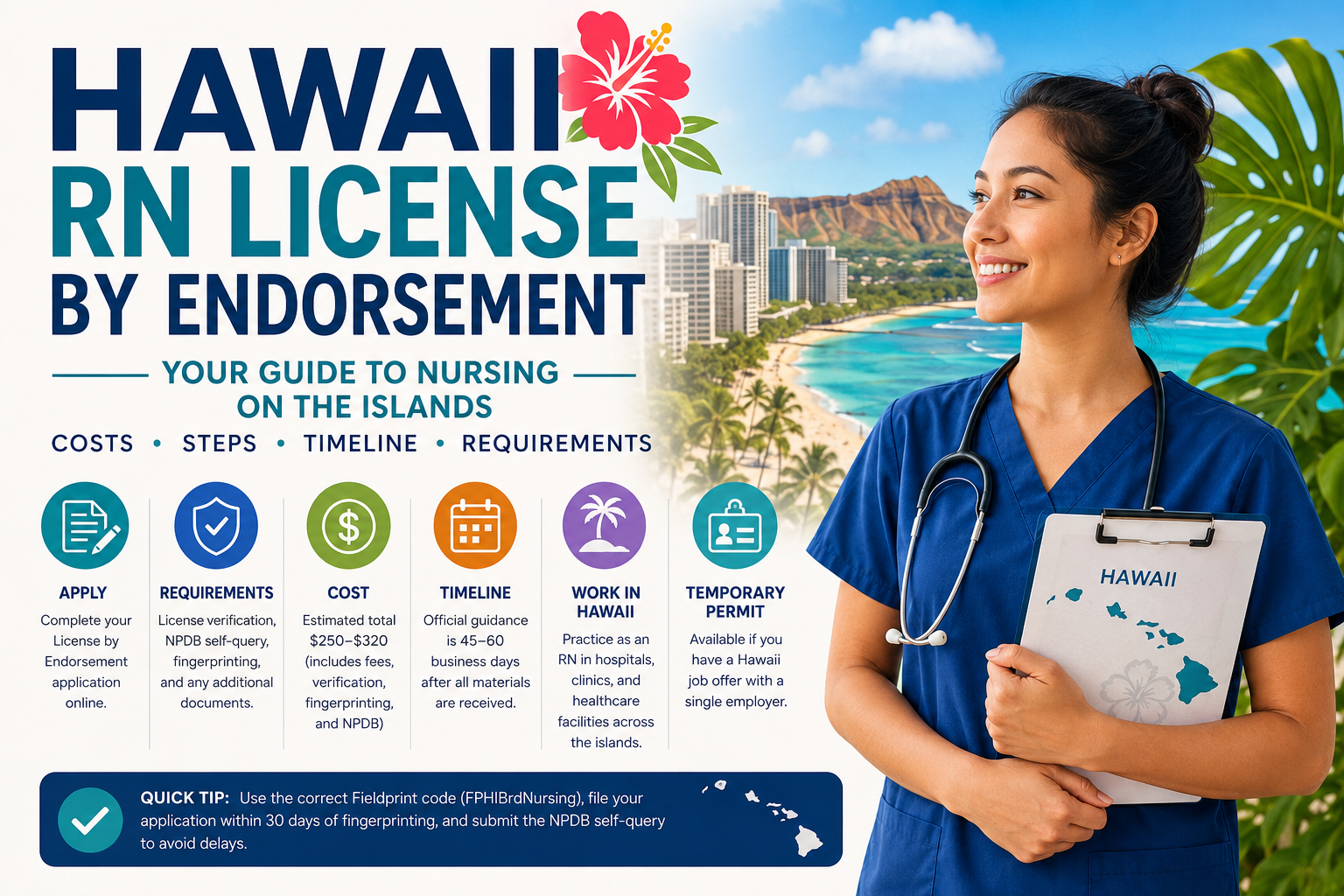
~$250–$320 |
A note on the license fee: Hawaii prorates the endorsement fee based on where you are in its two-year licensing cycle. All Hawaii nursing licenses expire on June 30 of every odd-numbered year, regardless of when they’re issued. So a license issued early in the cycle stays active longer before its first renewal and costs more, while one issued late in the cycle costs less because it expires sooner.
In practice that means roughly $234 if your license is issued between July 1 of an odd year and June 30 of an even year, and roughly $166 if it’s issued between July 1 of an even year and June 30 of an odd year. The MyPVL portal calculates the exact amount at checkout, and fees can change — always confirm the current figure with the Board before you pay.
Temporary Permit vs. Permanent License
Hawaii offers two routes. Which one fits depends mostly on whether you already have a Hawaii job lined up.
Permanent Hawaii RN License (License by Endorsement)
- No Hawaii employer required
- Allows unrestricted practice in Hawaii
- Best option if you’re considering relocating or just want to explore opportunities
- Can be completed online through the MyPVL portal in most situations
Temporary Permit
- A Hawaii employer is required — you must have already accepted a position with a single Hawaii health care entity
- That employer must sign and submit an Employment Certification Form on your behalf
- Intended for nurses who already have a Hawaii position and need to start work before the permanent license is finalized
- A standalone temporary permit is valid for up to 6 months; the combined Temporary Permit + License by Endorsement application is valid for up to 1 year
Important: Unlike the permanent endorsement application, the combined Temporary Permit + License by Endorsement application cannot be submitted through the online portal. It must be mailed or hand-delivered to the PVL office, and the fee is nonrefundable even if you turn out to be ineligible. If you don’t have a Hawaii job yet, skip the temp permit and apply for the permanent license online.
Application Steps
Step 1 — Start your application. Create an account through Hawaii’s MyPVL licensing portal and begin a License by Endorsement application: https://mypvl.dcca.hawaii.gov/
Step 2 — Request license verification through Nursys. Order verification of your current state license through Nursys (expect about $30). If your original licensing state does not participate in Nursys, you’ll need to contact that state’s board of nursing directly and have them send verification to the Hawaii Board. https://www.nursys.com/
Step 3 — Complete the NPDB self-query. Run a self-query through the National Practitioner Data Bank and submit the report. Hawaii accepts either the digital PDF or the original hard-copy report mailed in a still-sealed NPDB envelope. https://www.npdb.hrsa.gov/
Step 4 — Complete fingerprinting / background check. Schedule electronic fingerprinting through Fieldprint (about $52). You can do this in Hawaii or at a location in the continental U.S. You must use the Fieldprint code FPHIBrdNursing — without it, the Board can’t retrieve your results and you’ll have to redo it. Also note: you need to file your license application within 30 days of getting fingerprinted so the results can be matched to your file. https://fieldprinthawaii.com/individuals
Step 5 — Submit any additional documentation if requested. The Board may ask for education or NCLEX records. One thing to watch for: if you haven’t practiced nursing in the U.S. or a U.S. territory within the past 5 years, you may be required to retake the NCLEX or complete a Board-approved refresher course.
Step 6 — Wait for review and issuance. Once everything is in, the Board reviews your file and issues the license.
Timeline
Official guidance: roughly 45–60 business days after the Board receives all required materials.
In practice: many nurses report faster turnaround — sometimes within days once fingerprints and verifications land — but plan around the official window so a slower review doesn’t catch you off guard. The single biggest cause of delays is incomplete submissions, especially fingerprinting (wrong or missing Fieldprint code) and the NPDB self-query. Get those two right the first time and you’ll avoid the most common holdups.
Quick Tips to Avoid Delays
Use the right Fieldprint code (FPHIBrdNursing) and file your application within 30 days of fingerprinting.
Start the Nursys verification early — it’s often the slowest moving piece, especially if your home state isn’t on Nursys.
Submit the NPDB self-query exactly as the Board specifies (digital PDF or sealed original).
Don’t apply for the temp permit unless you already have a Hawaii job — it requires employer certification and a separate, nonrefundable fee.
Confirm current fees in MyPVL before paying, since the prorated license fee shifts with the two-year cycle.